
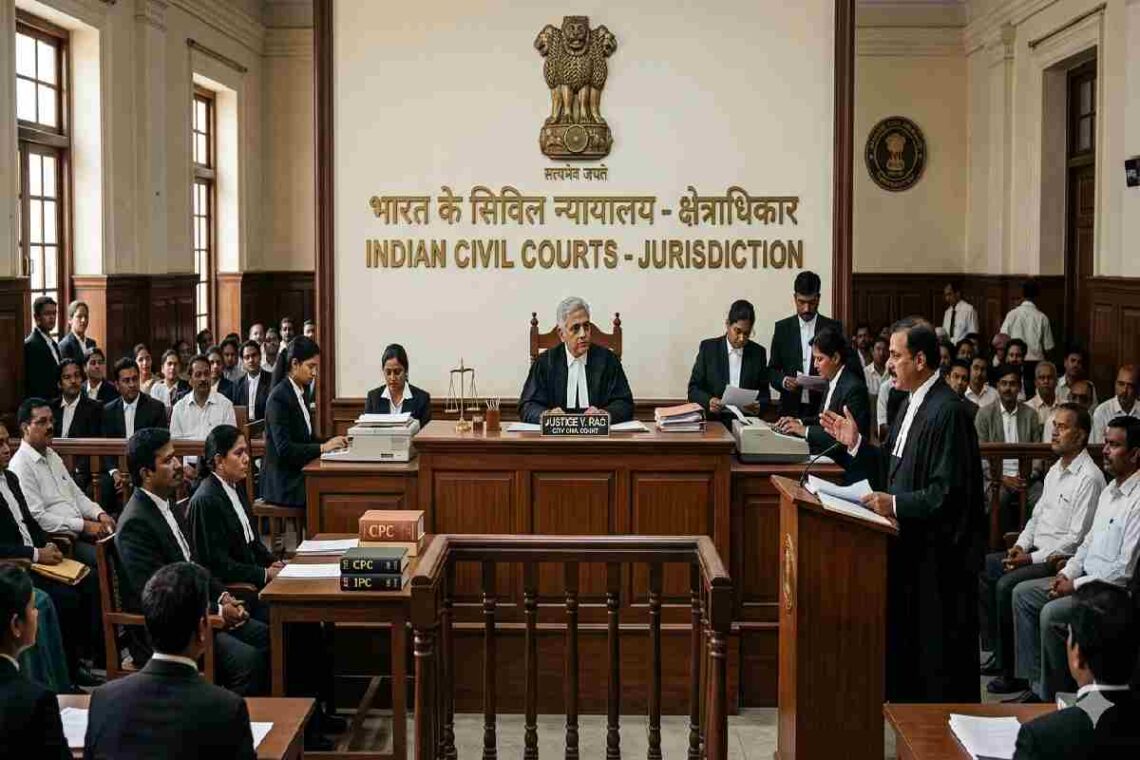
What is Jurisdiction in Indian Courts?
Jurisdiction is the cornerstone of the Indian judiciary, which empowers the Indian courts with the authority to entertain and adjudicate a specific case. It is a widely mentioned concept and is known as ‘Indians juristication’, which allows accurate, timely and fair justice to varied classes of disputes.
What is Jurisdiction?
Origin of the word jurisdiction: The word ‘jurisdiction’ has been derived from the two words ‘juris’ means Law and ‘diction’ means ‘to speak’. Therefore, the power and authority that are given to a court, in order to hear, to decide, and to make an order, are known as jurisdiction.In India, the aforesaid authority of the court has certain limits; be it in relation to territory, subject matter, valuation and others, to avoid the violation of rules.
According to the Supreme Court, it is the ‘authority’ of the court and a decree of the court passed without jurisdiction is void. It is stated that the jurisdiction may be invoked from constitutional provisions such as 131, 32 and 103 or judgments.
Types of Jurisdiction
Indian courts exercise various jurisdictions, categorised into ten main types for clarity.
| Type | Description | Example |
| Territorial | Limits to the geographic area where the cause arises or parties reside. | Case in Madhya Pradesh tried only by MP courts. |
| Pecuniary | Based on the monetary value of suit. | District courts handle claims up to specified limits. |
| Subject Matter | Specific case categories like civil or criminal. | Family courts for divorce matters. |
| Original | First hearing court. | Supreme Court for Centre-State disputes. |
| Appellate | Review of lower court decisions. | High Courts appeal from districts. |
| Exclusive | Sole authority, no sharing. | Supreme Court under Article 131. |
| Concurrent | Multiple courts can hear. | Civil and criminal matters overlap. |
| Special | For designated cases like consumer disputes. | Consumer forums. |
| Legal | Statutory powers. | Writ jurisdiction under Article 226. |
| Extending | Temporary expansion via transfer. | Supreme Court transfers cases. |
These types ensure structured justice, with CPC 1908 governing civil aspects.
- Territorial jurisdiction prevents forum shopping, requiring suits where the defendant resides or cause of action arises.
- Pecuniary limits vary by court; e.g., small causes courts for low-value claims.
- Subject matter excludes certain courts, like revenue courts for land disputes.
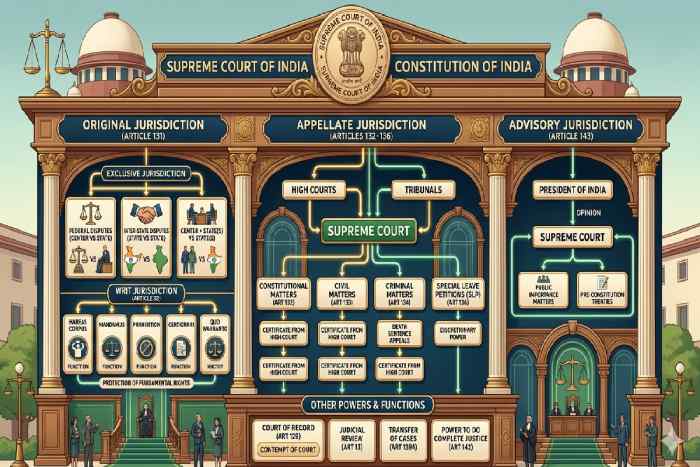
Jurisdiction of Supreme Court
Supreme Court has original, appellate and advisory powers. The original jurisdiction lies in disputes between the Centre and States and enforces Fundamental Rights with Writs.
The appellate jurisdiction provides for revision of High Court decisions, special leave under Article 136. Advisory jurisdiction gives a reply to the questions under Article 143, with reference to the President.
In 2026, pendency hit 93,143 cases by March, up from 92,828 in January. This reflects rising filings amid leadership changes.
High Courts Jurisdiction
India has 25 High Courts, six serving multiple states/UTs.
| High Court | Year Established | Territorial Jurisdiction | Seat/Benches |
| Bombay | 1862 | Maharashtra, Goa, Dadra & Nagar Haveli, Daman & Diu | Mumbai (Panaji, Aurangabad, Nagpur) |
| Calcutta | 1862 | West Bengal, Andaman & Nicobar | Kolkata (Port Blair) |
| Madras | 1862 | Tamil Nadu, Puducherry | Chennai (Madurai) |
| Allahabad | 1866 | Uttar Pradesh | Allahabad (Lucknow) |
| Punjab & Haryana | 1975 | Punjab, Haryana, Chandigarh | Chandigarh |
| Telangana | 2019 | Telangana | Hyderabad |
High Courts have original writ jurisdiction under Article 226, supervisory over subordinates, and appellate roles. They handle company law in some cases.
Pendency exceeds 63 lakh cases in 2026.
District Courts Role
The most significant category of civil/criminal matters at the local level comes under the jurisdiction of the District Courts presided over by the District Judges. The District Courts also hear appeals from the courts below it subject to restrictions both territorial and pecuniary.
With 4.85 crore pending cases (85% of total), they bear the heaviest load. Sessions Judges preside over serious crimes.
Current Statistics and Challenges
By early 2026, total pending cases would exceed 5.4 crore, whereas 5.39 crore were reported at the end of 2025. Cases that have been pending for over 30 years exceeded 180,000.
Pendency Distribution (2026 estimates):
To illustrate, consider this pie chart representation of case distribution:
- District Courts: 85% (4.85 crore)
- High Courts: 12% (63 lakh)
- Supreme Court: 0.2% (93,000+)
[Data derived from reports; Supreme Court at 93,143 in March 2026].
Challenges include judge shortages (21 per million people), government litigation (50% cases), and adjournments. COVID spiked pendency; 2024 methodology changes added counts.
| Court Level | Pending Cases (2026) | Increase from Prior Year |
| Supreme Court | 93,143 (Mar) | +10,383 since Jan 2025 |
| High Courts | 63+ lakh | Ongoing rise |
| Districts | 4.85 crore | 85% total |
| Total | 5.4 crore+ | Record high |
Recent Developments 2026
Pendency rose 510 cases in Jan 2026, 1,141 in March. CJI Surya Kant prioritises reductions post-2025 changes.
BCI withdrew the law college moratorium in March. AI tools and ‘Mediation for the Nation 2.0’ aim to streamline. Virtual hearings persist post-COVID.
Practical Implications for Litigants
Parties cannot contractually oust jurisdiction; such clauses are void under public policy. Forum selection valid if non-exclusive.
For businesses in Hyderabad (the user’s location), the Telangana High Court handles local disputes. NRIs file where cause arises or defendants reside.
- Check pecuniary limits before filing to avoid rejection.
- Use e-filing via NJDG for efficiency.
- Opt for Lok Adalats to reduce delays.
Cost Differences Across Courts
Filing fees vary by jurisdiction and value, impacting access.
| Suit Value (₹) | District Court Fee | High Court Fee | Supreme Court Fee |
| Up to 1 lakh | 1-2% | 1.5% | Fixed ~₹500 [Typical CPC schedules] |
| 1-5 lakh | 2% | 2% | N/A (Original rare) |
| Over 10 lakh | Capped at ₹15k-75k | Up to 2% | ₹5,000+ [ inferred] |
Lower courts cheaper for small claims; appeals escalate costs 2-3x. Legal aid available for low-income.
Reforms and Future Outlook
Initiatives like fast-track courts, e-courts, and judge recruitment target reductions. NJDG tracks real-time data.
Types of jurisdiction in Indian civil courts
Indian civil courts exercise jurisdiction under the Code of Civil Procedure, 1908 (CPC), primarily governed by Sections 9 to 20, which outline their authority to hear civil suits unless expressly or impliedly barred.
Core Types of Jurisdiction
Civil court jurisdiction falls into three fundamental categories: subject-matter, territorial (local), and pecuniary. These ensure cases reach the appropriate forum based on nature, location, and value.
| Type | Definition | Key CPC Provisions | Example |
| Subject-Matter | Court’s power to handle specific civil disputes (e.g., contracts, property). Excludes barred matters like arbitration awards. | Section 9 (general jurisdiction) | Property suits in civil courts, not revenue courts. |
| Territorial/Local | Geographic limits where defendant resides, cause of action arises, or property is situated. | Sections 15-20 | Suit for debt filed where debtor lives. |
| Pecuniary | Monetary value limits of the suit or appeal. Varies by court grade and state laws. | Section 6, state Civil Courts Acts | Munsif court up to ₹1-2 lakh (state-specific). |
These limits prevent null decrees; lack thereof renders judgments void ab initio, as in Kiran Singh v. Chaman Paswan.
Original vs. Appellate Jurisdiction
Civil courts also divide into original (first instance) and appellate (review) roles.
- Original Jurisdiction: Courts like Munsif, Civil Judge (Junior/Senior Division), and District Courts hear suits initially. High Courts have limited original civil jurisdiction in presidency towns (e.g., Bombay, Calcutta, Madras).
- Appellate Jurisdiction: District Courts appeal Munsif decisions; High Courts hear first/second appeals from District/lower courts. Supreme Court via special leave (Article 136).
| Court Level | Original Limit Example (₹) | Appellate Role |
| Munsif/Small Causes | Up to 1 lakh | None |
| Civil Judge Junior | 1-5 lakh | None |
| Civil Judge Senior/District | Unlimited (subject to pecuniary) | First appeals from lower courts |
| High Court | Varies; unlimited in some original suits | First/Second appeals |
Exclusive and Concurrent Jurisdiction
-
Exclusive-Special tribunals like Consumer Forums and Labour Courts are not amenable to the jurisdiction of civil courts. Specific statutory exclusory bars
-
Arbitration Act; there is an implied bar when the statute itself provides a complete and adequate remedy.Concurrent-More than one forum may have jurisdiction
Practical Implications
Suits must be filed at the lowest competent court (Section 15 CPC) to avoid transfers/delays. For immovable property, jurisdiction lies where the property is situated (Section 16). E-filing via e-Courts streamlines compliance.
In Telangana (Hyderabad context), pecuniary limits follow state amendments: Junior Civil Judge up to ₹3 lakh, Senior up to ₹10 lakh. Always verify local rules for accuracy.
Conclusion
Mastering Indians juristication ensures the right forum selection, saving time and costs. With rising pendency, understanding types empowers informed legal strategies.