
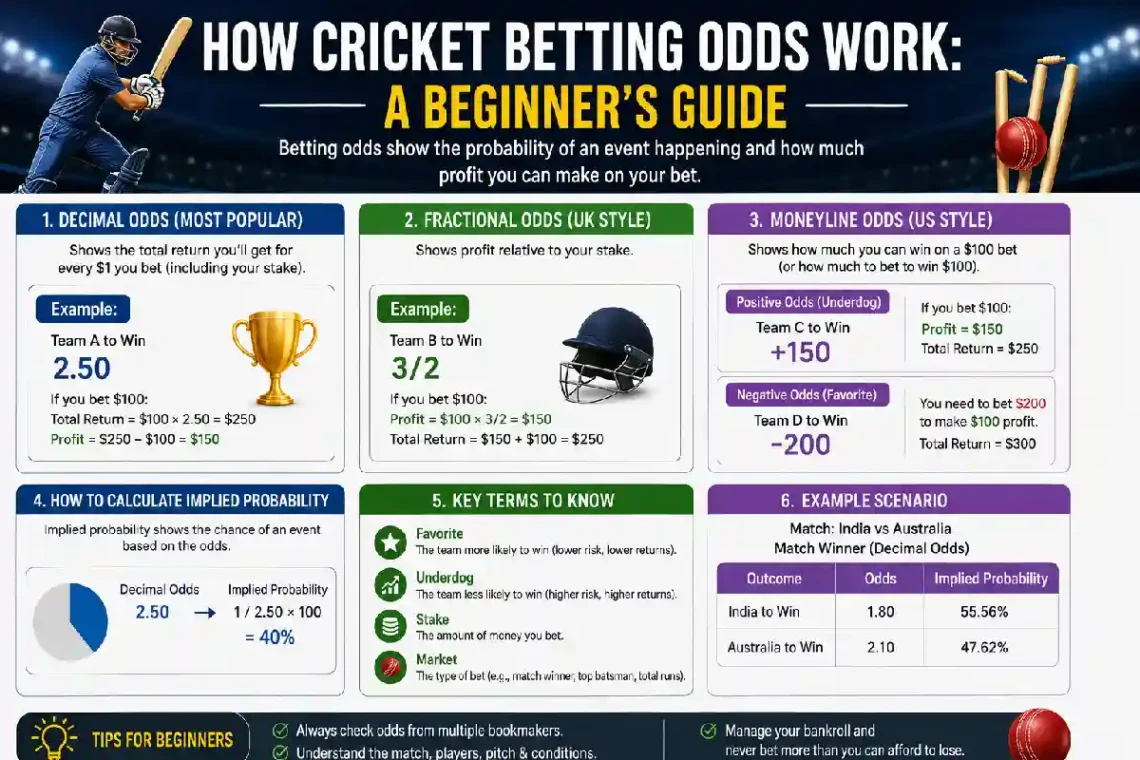
Odds are the language of betting, and yet many people place bets without fully understanding what the numbers mean. That is a shame, because once you grasp how odds work, every bet becomes clearer – you can see what you stand to win, judge whether a price is fair, and spot the value that separates good betting from guessing. This guide explains cricket betting odds from the ground up, in plain English, with no maths beyond simple multiplication.
Master this, and you will read a betting market with far more confidence than someone who simply picks a name and hopes.
What Odds Actually Represent
At their core, odds do two things at once: they tell you how much you can win, and they express how likely an outcome is judged to be. A short price (a low number) means an outcome is considered likely, so the reward is small. A long price (a high number) means it is considered unlikely, so the reward is larger. Every set of odds is really a statement about probability dressed up as a payout.
Understanding this dual nature is the key to everything else. When you look at a price, you are not just seeing a potential return – you are seeing the market’s opinion of how probable something is. Learning to read that opinion is what turns a casual bettor into an informed one.
Decimal Odds Explained
In India, and on the exchanges most cricket IDs connect to, odds are shown in decimal format, which is refreshingly simple. The number is the total you receive for each unit staked, including your stake back. Odds of 2.0 mean you double your money: bet 100 and, if you win, you receive 200 (your 100 stake plus 100 profit). Odds of 1.5 return 150 for a 100 stake; odds of 3.0 return 300.
To find your potential return, you simply multiply your stake by the decimal odds. That is the whole calculation. This clarity is one reason decimal odds have become standard – there is no fractions to convert, no mental gymnastics, just stake times price equals return.
From Odds to Probability
Here is where odds get genuinely useful. You can convert any decimal price into an implied probability by dividing 1 by the odds. Odds of 2.0 imply a 50% chance (1 divided by 2.0). Odds of 4.0 imply a 25% chance. Odds of 1.25 imply an 80% chance. In other words, the price is telling you exactly how likely the market thinks the outcome is.
This is a powerful lens. Once you can see the probability behind a price, you can ask the crucial question: do I think the real chance is higher or lower than the odds suggest? If you believe an outcome is more likely than its implied probability, you may have found a good bet. That comparison is the foundation of all thoughtful betting.
The Bookmaker’s Margin
There is one catch with traditional bookmakers. If you add up the implied probabilities of all outcomes in a market, they come to more than 100%. That extra slice above 100% is the bookmaker’s margin, or ‘overround’ – the profit built into the odds. It means the prices are quietly shaded against you, so the odds you see are slightly worse than the true probability would justify.
This margin is why betting against a bookmaker over time is an uphill battle: you are not just trying to predict outcomes, you are trying to overcome a built-in edge on every single price. Understanding that the margin exists is the first step to seeking out better value elsewhere.
Why Exchange Odds Are Different
Betting exchanges – the platforms most cricket accounts connect to – work differently, and it shows in the odds. Because prices come from users betting against each other rather than a bookmaker protecting a margin, exchange odds tend to sit much closer to the true probability. The combined implied probabilities are far nearer 100%, which means better value on almost every market.
This is a big reason the exchange model has become dominant, and why it is worth knowing that the various different types of cricket ID generally connect to exchanges rather than fixed-odds bookmakers. Sharper odds, closer to true probability, are a structural advantage that compounds over many bets.
Understanding Value
All of this leads to the single most important concept in betting: value. A value bet is one where the odds are higher than the true probability of the outcome – where the price overpays you for the risk. Finding value consistently, not simply picking winners, is what makes betting sustainable, because you can back a losing selection at a great price and still come out ahead over time.
Spotting value does not require complex maths, just the habit of comparing the implied probability of a price against your own honest estimate of the real chance. When your estimate is meaningfully higher than the market’s, you have found value. When it is lower, you should pass. That simple discipline, applied over many bets, is the essence of betting well.
Odds in Practice
Put it all together and a betting market transforms from a jumble of numbers into a readable picture. You glance at a price, translate it into an implied probability, compare that to your own view of the match, and bet only when you believe you are getting more than fair value. You also favour exchange prices, knowing they are less shaded than a bookmaker’s. None of this guarantees a win on any single bet – nothing does – but it stacks the long-term odds in your favour.
That shift, from betting on names to betting on value, is the mark of someone who understands odds. It will not make you win every time, but it will make you a far more thoughtful, disciplined, and ultimately more successful bettor than one who never looks past the potential payout.
A Worked Example
To see how this all fits together, consider a simple example. Suppose a team is priced at 1.8 to win a match. Dividing 1 by 1.8 gives an implied probability of about 56% – the market thinks this team has a 56% chance. Now ask yourself: based on the conditions, the form, and the match-up, do you genuinely believe their chance is higher than 56%? If you think it is really more like 65%, the price offers value, because you are being paid as if the outcome is less likely than you believe it to be.
Flip it around, and the discipline becomes clear. If that same team were priced at 1.4 – an implied probability of about 71% – and you still only rated their real chance at 65%, the price now offers poor value, even though they are the favourite. You would be paying more than the outcome is worth. A thoughtful bettor passes on this bet despite backing the same team a moment ago at a better price, because the decision is about the price, not the team.
This is the crux of understanding odds: the same selection can be a good bet at one price and a bad bet at another. Casual bettors fixate on who they think will win; informed bettors fixate on whether the price fairly reflects that chance. Running this quick mental check – implied probability versus your own honest estimate – before every bet is the habit that, more than anything else, separates the two.
Frequently Asked Questions
How do decimal odds work? The number is your total return per unit staked, including your stake. Odds of 2.0 double your money; multiply your stake by the odds to find your potential return.
How do I turn odds into a probability? Divide 1 by the decimal odds. Odds of 2.0 imply a 50% chance, 4.0 imply 25%, and 1.25 imply 80%. This shows how likely the market thinks the outcome is.
What is the bookmaker’s margin? The profit built into a bookmaker’s odds, which makes the implied probabilities add up to more than 100%. It means the prices are shaded slightly against you.
What is a value bet? A bet where the odds are higher than the true chance of the outcome – where the price overpays you for the risk. Finding value consistently is the key to betting well.
A Note on Responsible Play
Understanding odds makes you a sharper bettor, but no knowledge removes betting’s risk. Treat it as entertainment, not income. Set a budget you can afford to lose before you deposit, keep your stakes sensible, and use the deposit limits and self-exclusion tools reputable platforms provide. Betting rules vary by state across India, so check your local position, and never chase a los