
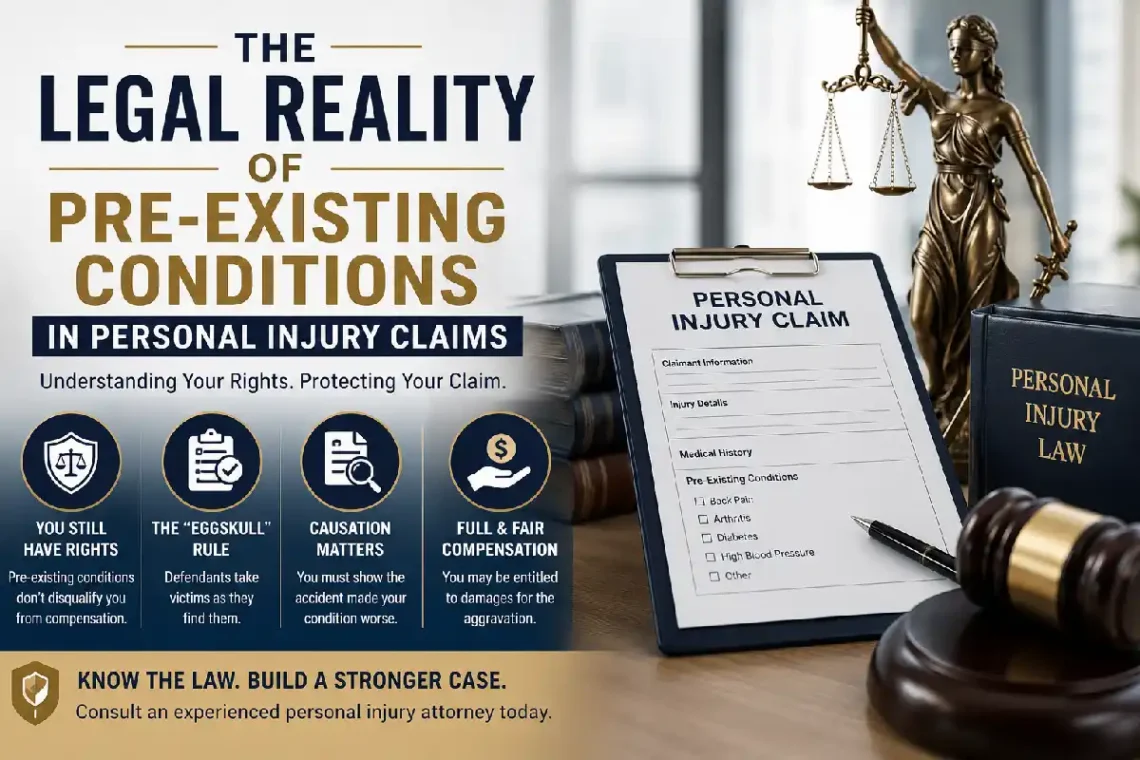
If you already have an injury or illness that was affected by the accident, you must be able to show how the incident aggravated the existing condition. This is the only way you can recover damages for it. For example, if you have a back injury and it’s worsened in a car crash, you can seek compensation for that worsening as part of your overall claim. However, even if you can prove the accident had an impact on the pre-existing condition, expect an uphill battle against the other driver’s insurance company.
The Myth Of The “Clean Slate” Requirement
One of the most harmful myths out there about personal injury cases is this notion that you need to be in perfect health before an accident to have a claim. That’s not the law, and it never has been the law.
The fact is most adults are living with something. Some 20.4% of U.S. adults – that’s more than 50 million people – struggle with chronic pain. The most common is lower back pain (National Center for Health Statistics). So logic dictates that a good chunk of anyone injured in an accident already had something going on. To bar them all from their day in court would be both inequitable and almost logistically impossible.
What the law actually says is you have to prove two things: The defendant’s negligence caused your injury, and the accident exacerbated your condition. You’re not owed damages for pain you were already experiencing, but you are owed full compensation for each additional measure of harm caused by someone else’s negligence.
The Eggshell Skull Rule and Why It Protects You
The eggshell skull rule is one of the oldest doctrines in tort law. It gets its name from the classic explanation given by a nineteenth-century judge: “If a man, by a careless act, sets on foot the striking of another who is in a state of a broken skull, he is answerable for the whole mischief.” In other words, if a plaintiff’s pre-existing vulnerability makes his injuries worse than they would have been for a healthy person, tough luck for the defendant. The defendant must take the plaintiff as he finds him.
Aggravation Versus A New Injury – and Why The Distinction Matters
There is a clear difference from a legal perspective distinguishing if someone suffers a brand new injury or if a pre-existing condition is aggravated by an accident. With a new injury, the person has never been injured, shares the status, and the accident caused it. On the other hand, with an aggravated condition, the court process requires what is called apportionment of damages – which is to separate the baseline pain and disability the plaintiff was already experiencing from the additional suffering caused by the new trauma.
You can’t recover for the pain you were dealing with before someone hit you. But you can absolutely recover the difference between both situations. If degenerative disc disease caused you some occasional pain, but did not affect your ability to work, and the accident turned that pain into a condition of constant pain that required surgery, you’re entitled to compensation for that shift.
In legal terms, courts refer to the concept of a proximate cause here – which is the requirement that the defendant’s negligent act directly caused the worsening. Proving proximate cause in aggravation cases almost always requires expert medical testimony, which we’ll get to in just a bit.
How Insurance Companies Weaponize Your Medical History
From the moment you’re injured, the insurance company is already building a case against you. Insurers know that their biggest advantage comes before you’ve had a chance to speak to an attorney, while you’re still reeling from the accident and worrying how you’ll pay your upcoming medical bills.
That’s when they’ll try to get you to make a statement that they can use against you. They’ll offer you a quick, lowball settlement hoping you’ll jump at a fast solution rather than try to fight for what you deserve. They might even try to convince you that you don’t need a lawyer at all.
Once you file a claim, the insurance company has an official reason to start building their argument, but they’ve been laying the groundwork since the moment you hit the ground. But you can level the playing field.
The good news is that it’s not as hard as it sounds. The first, most important steps are to be vigilant about what you say after your accident and make sure you see a lawyer before you say anything official to the insurer. Countering these tactics requires someone who knows how insurance adjusters construct these arguments before they’ve fully built them. Retaining an experienced Philadelphia personal injury lawyer gives you access to legal strategy and medical expert resources that directly challenge the defense’s attempt to repackage your new injuries as old ones.
The Independent Medical Examination Trap
If you’re going through a personal injury claim, you may have to go through an independent medical examination. And, hint, the “independent” part is misleading. Doctors that perform these exams are hired by the defense and/or the insurance company. Their job is not to objectively evaluate you – it’s to write a report that helps the defense.
For instance, in cases where there’s a pre-existing condition, such as degeneration on the spine, the IME doctor will demand all of your pre-accident medical notes. They’ll ask for any former imaging of the area, old treatment records, and documentation of symptoms in relation to the part of your body that was injured in the accident. Then, the report that the defense-paid doctor writes will basically state that your current symptoms can be attributed to natural degeneration or the pre-existing condition. The accident didn’t lead to any new physiological issues – you were going to feel like this, no matter what.
Your lawyers will know this and go in with a plan. Records and the treating physician’s background, for example, are largely in your favor and carry more weight than a rushed examination by the defense’s payee.
When Dormant Conditions Become Active – The Asymptomatic To Symptomatic Shift
Some of the strongest pre-existing condition cases are those where injuries or conditions were truly “silent” prior to the accident. Asymptomatic degenerative changes, dormant arthritis, or herniated discs that caused no pain or functional limitation are not “injuries” in any meaningful sense prior to the crash. They become injuries – legally and medically – when they are activated by trauma.
The legal concept that applies here is the shift from asymptomatic to symptomatic. If your imaging from two years before the accident showed relatively minor disc degeneration, and you had no pain at that time, then two weeks after the accident began suffering chronic radiating pain and could no longer move around as you once did, the law recognizes that the accident caused something very real. The fact that there was a biological vulnerability present does not change the fact that the defendant’s negligence is what caused the activation of said vulnerability.
Like everything else, these cases require very careful documentation of what your functional baseline was before the accident and how dramatically it changed afterward. In other words, your medical condition pre-existed the accident, but the disability did not. It’s your job to prove the difference.
The Expert Medical Witness and Why They’re Non-Negotiable
In all pre-existing condition cases, the testimony of a qualified medical expert is not merely important to your case – it’s essential. Lay witnesses and family doctors can say that you weren’t having those symptoms, but it takes a specialist who is board-certified in that field of medicine to give an opinion that crosses over into the “standard of proof” territory in the law.
For surgeons speaking to juries or adjusters, the most effective presentation is through the objective findings in their own chart notation: The claimant told me she had right leg pain for two years but that has worsened since the accident. More in-depth explaining is required to translate that into legalese as above the level of pain in the medical record as a result of the accident and beyond the level of baseline pre-existing pain.
Don’t Conceal Your History – It Will Cost You The Case
Failing to disclose a pre-existing condition to either your lawyer or your physicians can quickly derail your personal injury claim. Most defense attorneys will unearth previous medical records during the discovery process. If their findings contradict the information you’ve provided and your case is built on passable lies rather than solid evidence, opposing counsel and the jury will likely see through you.
There’s also a strategic reason for full transparency. Your lawyer needs to know what you’re up against. Does the fact that you have a history of back problems mean your current symptoms can be easily explained? Does the fact that you once sprained the same ankle weaken your case? If your lawyer doesn’t have all the facts, he or she can’t develop the best strategy for presenting your case. If you’re up front from the beginning, your lawyer can explain in a straightforward manner why, despite your previous injury, this situation is different.
What You Should Be Doing Right Now
If you suffered an injury and you have a similar previous medical history, do not underestimate any of these steps. Follow all of them. Stick with your treatment plan and attend all recommended appointments. Insurance adjusters will take note of any gaps in treatment when they try to argue your condition isn’t as severe as you claim. Begin keeping a pain journal and record the exact ways in which your activities have been limited since the accident – this creates a contemporaneous record that’s much harder to challenge than retrospective testimony.
Most importantly, you need to convince the adjuster that your pre-existing condition wasn’t the real cause of your current injury. This is often best achieved via objective evidence, like the mechanism of injury being documented in your treating physicians’ reports. In other words, you want their notes to say something like “patient reports shoulder pain after being struck by the defendant’s vehicle” or “knee began giving out after the defendant rear-ended me.” Proof that the plaintiff’s condition is a direct result of the defendant’s actions, as recent as possible after those actions, goes a long way toward prevailing in these disputes.