
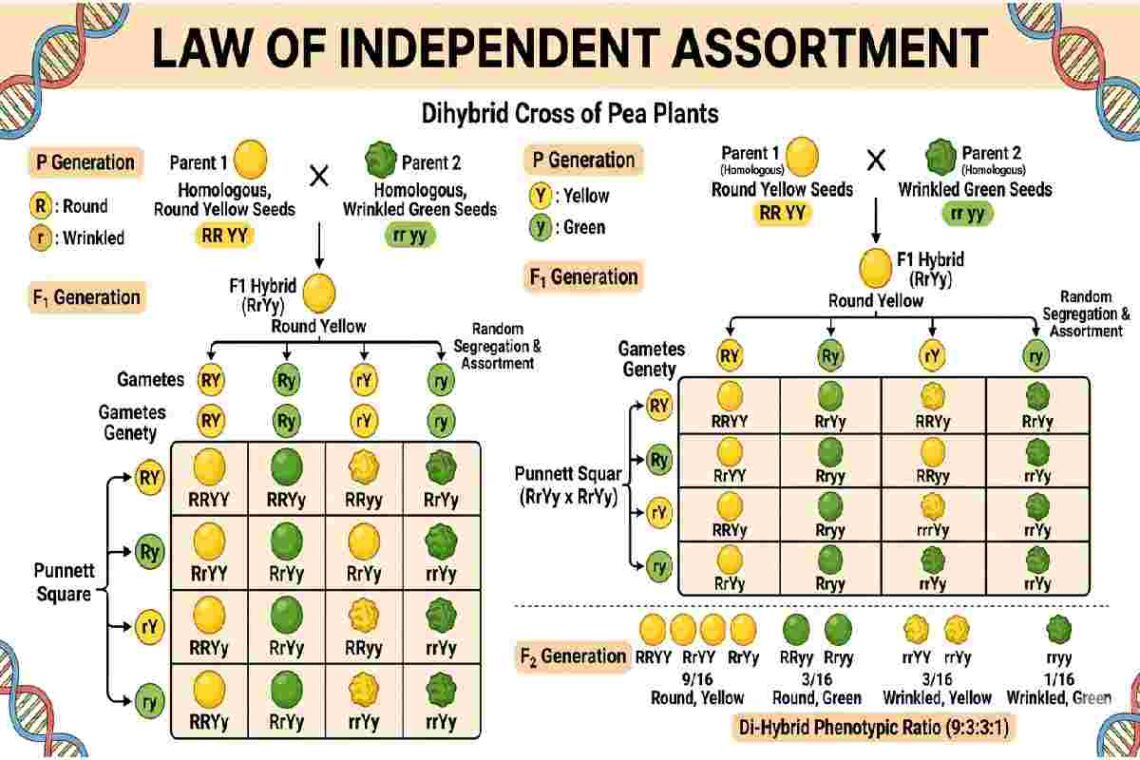
Law of Independent Assortment Class 10. The law of independent assortment means that when two pairs of alleles segregate together, they segregate independently of each other during the formation of gametes. In simple words, inheriting a trait does not affect the inheritance of the other, provided that they are not linked.
What does the Law of Independent Assortment mean?
Laws of independent assortment: when the alleles of one pair of characters segregate along with the alleles of the second pair. Merely inheriting one characteristic does not determine if a second characteristic will be inherited.
Example: Plants were examined for their seed shape and seed colour in Mendel‘s experiment. In a plant whose genetics were, for instance,
R – Totally says at36%. We run an advertising campaign: your cost:33%.78 (Yeah, I know, advertising costs so much nowadays. But?..) Put these together: eight, it‘s probably 17% (honestly, six-eight, thirty-percent, and seventeen. 6. Looks right to me). And there you have it–roughly 36% of our total budget.
Y – A. Yxiv(x)Yxk(y),0≤x,y≤1, where Yxk 0 and x,y are chosen consistent with the design. The variance is miny{i(x)Ni 0,(Ni 1)} in the roots may be estimated by using the fact that (Ni 1) is binomial with an estimated probability Pxk= B(i; 1; pxk).
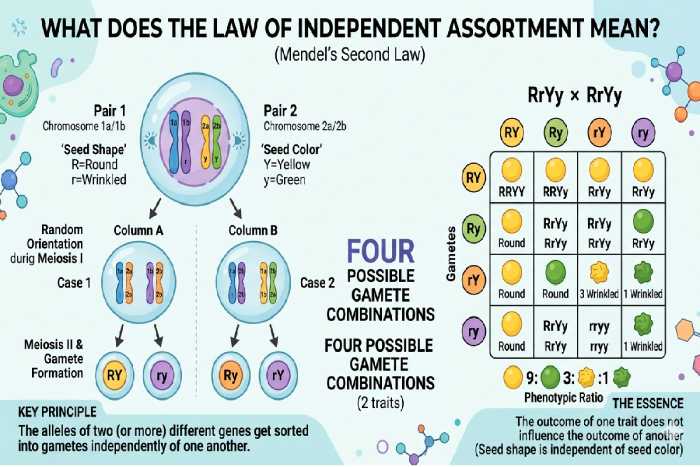
RrYy: Both alleles are possible for each gene, so Y can be surmounted by both R and r at the same time in four types of gamete, these are RY, Ry, rY, and ry. Crossing these gives the ratio of the F2 to be a typical 9:3:3:1 proportion:
A short exam-style answer would be: “The law of independent assortment applies to different genes. It is demonstrated in a dihybrid cross of seed shape and seed colour in pea plants”.
Why it matters.
This principle explains how there can be a variety of genes inside a population of organisms that reproduce sexually. As well as this, it explains the situation whereby children may have a different gene combination from either of their parents.
For school exams, it is generally referenced to the experiments on the pea plant by Mendel and the ratio of the F2 generation as 9:3:3:1. This ratio is the best indication of the two traits as segregating independently.
Example of a Dihybrid cross
An example worth noting is that of pea plants, which can have either seed shape or seed colour. If the round seed shape is dominant over wrinkled, and the yellow colour is dominant over green, Mendel crossed plants that differed in two characters:
In the F1 generation, all the offspring differed in the dominant trait, and F1 plants, when crossing F1 plants, produced the F2 generation that produced the four combinations. These combinations resulted in a phenotypic ratio of 9 round yellow : 3 round green : 3 wrinkled yellow: 1 wrinkled green.
A simple way to remember it
- One trait is not ‘moving towards’ the other trait.
- Each pair of alleles segregates independently.
- New combinations emerge in the offspring.
- The classic F2 resolution is 9:3:3:1.
Exam-ready definition
You can write this in an answer sheet:
Laws of Independent Assortment: When two or more pairs of contrasting characters are inherited independently of each other, then the alleles of each pair segregate independently.
For a somewhat more detailed answer, say that this law is illustrated by a dihybrid cross and by the fact that new combinations of traits appear in the F 2.
Punnett square notion
A dihybrid cross indicates that each parent is capable of forming a variety of gametes due to the independent assortment of alleles. In the quintessential example, the heterozygous F1 plant can produce four types: YR, Yr, y R, and yr.
However, when produced gametes fuse, the result will be that the offspring will have various possible combinations, not necessarily just the combination of the human parents. This is the main piece of evidence used to explain the law in school biology.
Segregation versus difference
- The law of segregation: Both alleles for one gene pair.
- The law of independent assortment: Alleles for two gene pairs separate independently.
- The importance of separating these is to reduce student error in exam conditions.
- A straightforward mnemonic is: segregation = one gene, independent assortment = two different genes.
Whether doesn‘t seem to really be adjustable
The law holds, more or less, for unlinked genes. However, linked genes can easily fail to predict independent assortment. In current genetics, this is one of several reasons the law is sometimes said to be a rule of thumb, not an absolute rule for every gene pair.
Typically, for class 10, you only need the concept and the classic Mendelian pea plant example. When mentioning exceptions, keep it brief and straightforward.
Typical errors:
- Claiming that the law applied to only one gene.
- Forgetting that this applies to 2 (or more) pairs of traits.
- *confusion between independent assortment and segregation.
- Omissions of the 9:3:3:1 ratio in a dihybrid cross.
Quick revision table
| Topic | Meaning |
| Law of independent assortment | Alleles of different genes segregate independently |
| Type of cross | Dihybrid cross |
| Classic ratio | 9:3:3:1 in F2 |
| Main use | Explains genetic variation |
FAQ Section
What does Independent Assortment mean in class 10?
This is the reason for alleles of different genes assorting independently from one another when forming gametes.
What is an independent assortment example?
A dihybrid cross in pea plants (like seed shape and seed colour) is the classic example of:
What is the rate of independent assortment?
The most common F2 phenotype ratio is 9:3:3:1.
What is unlike the law of segregation?
Segregation describes the separation of alleles of a single gene, while independent assortment describes the separation of alleles of two separate genes.
Final Conclusion
The law of independent assortment class 10 explains how unlike characters are inherited independently, and the easiest way to understand the dihybrid cross.