
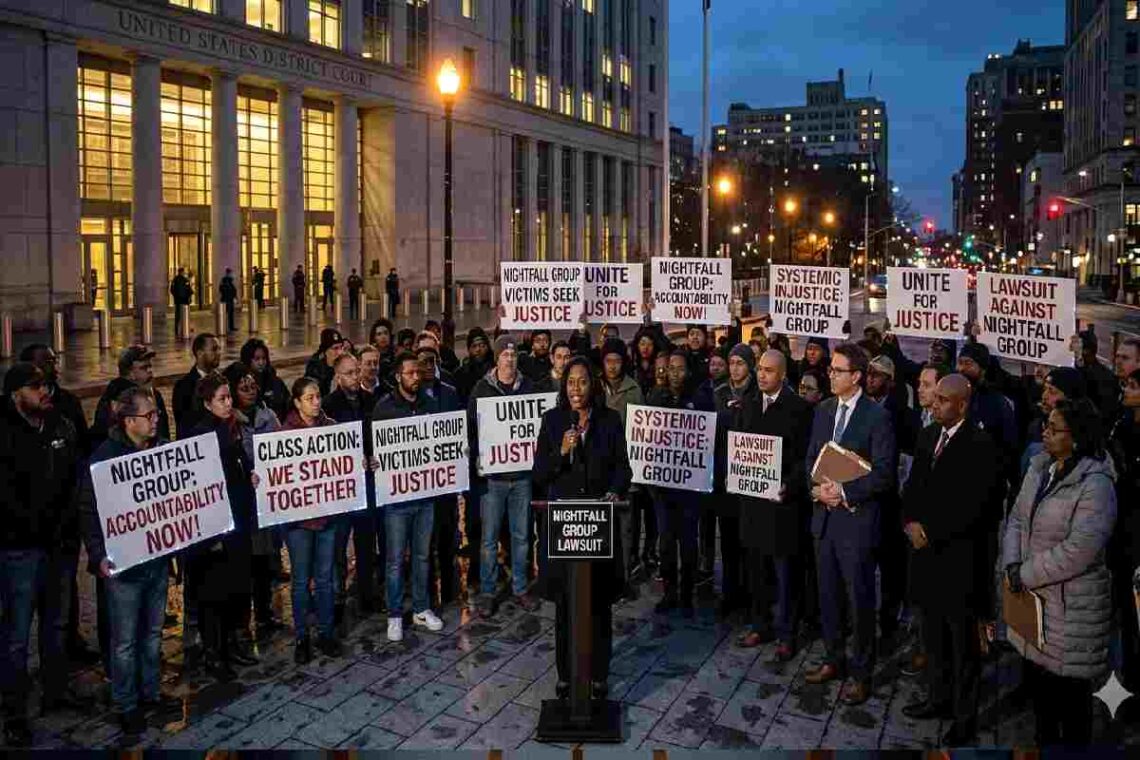
The Nightfall Group lawsuit shows how an enforcement crackdown on luxury short-term rentals may further transform these properties into black market party houses. This suit, filed in Los Angeles (part of a broader city investigation opened in 2023), found Nightfall to have gross violations of the City’s codes. By 2025, partial settlements were reached in the lawsuit.
What is the Nightfall Group Lawsuit?
The “Nightfall Group lawsuit” denotes documented civil legal actions taken against the company, not criminal actions. These civil claims are based on business dealings between clients, investors, other partners, or service providers.
Please consider:
- A lawsuit is not factual-it only implies that a cause for action was presented
- Legal actions are not uncommon in the high-end real estate and rental business
- Liability is determined by only court judgments and/or legal settlements; never just by a complaint and lawsuit
At the time of this writing, there is no court ruling that indicates the Nightfall Group has illegally acted.
Case Background
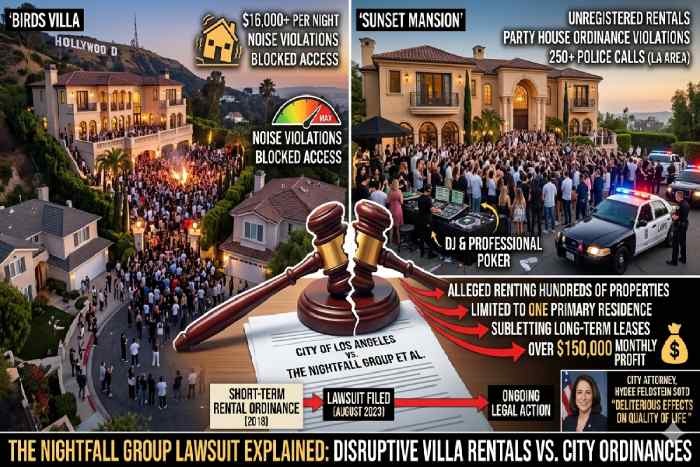
Mokhtar Jabli owned a business called Nightfall Group and Ultimate Host LLC. The Beverly Hills, CA based company listed homes on the internet that were presented as “villas”- luxury homes located in Hollywood Hills and Beverly Hills where the property was long-leased and then short-term leased to third parties through services like Airbnb. In fact these homes are regularly used as venues for opulent parties.
The suit People of California v. Ultimate Host LLC DBA Nightfall Group et al. Was filed August 16, 2023, by City Attorney Hydee Feldstein Soto. In the suit Nightfall, Jabli, and the owners of the properties were targeted for creating public nuisances in the form of unregistered short-term leases and parties. Nightfall Group and Mr. Jabli provided what they billed as “bespoke” experiences with pools, dj booths, and a concierge but utilized shell companies and rotating bank accounts to evade identification.
Key Allegations
LA accused Nightfall of flouting multiple ordinances:
| Allegation | Description | Evidence Cited |
| Short-Term Rental Ordinance Violation | Only primary residences can be rented short-term; must register. Nightfall ran dozens unregistered. | 100+ properties via shells |
| Party House Ordinance Breach | Bans commercial events, noise > residential norms. | 250+ LAPD calls (2021-2023) for fights, traffic |
| Public Nuisance | Blocked streets, unsafe crowds (100s per event). | 200+ emergency calls |
| Unfair Business Practices | Competitive edge over compliant hosts via evasion. | Multiple platform accounts |
Over 250 police responses in Hollywood alone highlighted chaos: loud music, brawls, road blockages.
Incident Examples
Nightfall properties hosted “blowouts” with live DJs, alcohol-fueled raves, drawing celebrities and influencers. Neighbors reported:
- Traffic jams on narrow streets.
- Fights spilling onto lawns.
- Noise past 2 AM.
City logs showed 200+ complaints, building a strong nuisance case.
Legal Proceedings
Filed in LA Superior Court, the suit sought injunctions halting operations and penalties up to $2,500 per violation—potentially millions given scale.
- 2023: Initial filing; discovery reveals shell ops.
- 2025: Partial settlements with owners like Kirill Ayzenberg ($280K total est.), prohibiting future STRs.
- 2026: Core claims vs. Nightfall/Jabli active; no full resolution per records.
Defenses: Nightfall argued compliance as “long-term sublessors,” not direct hosts; some suits from vendors allege non-payment, fraud.
Settlements and Penalties
By Feb 2025, the City Attorney announced deals returning properties to long-term housing:
- Property owners paid fines and banned STRs.
- Total penalties ~$280K across defendants.
| Settled Defendant | Penalty (Est.) | Terms |
| Kirill Ayzenberg/Gabriel Mark Trust | $100K+ | No future STRs |
| 5554 Green Oak LLC | $80K | Injunction |
| Jungle Kerry Inc. | $100K | Compliance monitor |
Nightfall itself faces ongoing litigation; potential for business overhaul or shutdown.
Impact on Stakeholders
Property Owners
Owners leased to Nightfall for steady income but faced nuisance suits. Post-settlement, many returned to traditional rentals, easing LA’s housing crunch (rent-stabilized units restored).
- Risks: Fines, lost licenses.
- Lessons: Vet lessees for STR compliance.
Guests and Hosts
Luxury renters (nightly $5K-$20K) enjoyed villas but contributed to chaos. Platforms delisted properties.
| Rental Type | Nightfall Pricing (Nightly) | Legal Compliant Avg. |
| Hollywood Hills Villa | $10K-$15K | $3K-$5K [est.] |
| Beverly Hills Mansion | $20K+ | $8K-$12K |
Hidden fees, false ads alleged in parallel suits.
Neighborhoods
Hollywood/Bel Air saw relief: fewer parties, restored quiet. Case accelerated LA’s STR enforcement.
Broader Short-Term Rental Trends
LA’s ordinances limit STRs to primary homes (1 per host, registered). Nightfall exemplifies “rogue” ops amid national crackdown:
- 2023-2026: Cities like NYC and SF tightened rules.
- Violations cost: $12B U.S. nuisance claims yearly.
Pie chart concept for STR violations (LA data est.): Party houses 40%, Unregistered 30%, Nuisance 20%, Fraud 10%.
| City | STR Rules | Avg. Penalty |
| Los Angeles | Primary only | $2,500/violation |
| New York | 30-day min. | $5K+ [similar] |
| San Francisco | Registration req. | $1K/day |
Nightfall Group’s Business Model
Nightfall positioned as a luxury concierge: villas with staff, events. Revenue from premiums, but evasion scaled ops to 100+ properties.
- Strengths: High margins (50%+ on sublets).
- Weaknesses: Regulatory blind spots.
Post-suit, site is active but low-key; possible pivot to compliant models.
Similar Lawsuits
Nightfall faced vendor suits (2023): non-payment for services, fraud in mansion deals. Parallels:
- Airbnb mega-hosts fined in Miami ($1M+).
- Party house ops in Austin settled $500K.
| Year | Similar Case | Penalty/Outcome | Location |
| 2023 | Ultimate Host vendor suits | Pending | LA |
| 2024 | NYC rogue STRs | $2M fines | NY |
| 2025 | SF party villas | Injunctions | CA |
20+ annual U.S. STR nuisance suits rising 15% post-COVID.
Regulatory Landscape
LA’s Home-Sharing Ordinance (2021) mandates registration; the Party House Ordinance caps events. Enforcement via the Public Rights Branch ramped up under Feldstein Soto.
- Best practices: Register, limit to primary, cap guests.
- Tech: Platforms now verify compliance.
Economic Analysis
Nightfall’s model: Lease at $20K/mo, sublet $10K/night = massive profits pre-suit. Violations cost: $2.5K x 100s = $1M+ potential.
| Cost Breakdown | Nightfall Est. | Compliant Host |
| Fines/Penalties | $280K+ paid | Minimal |
| Lost Revenue | 50% drop | Stable |
| Legal Fees | $500K+ | $10K/yr |
Housing impact: 10+ units back to market.
Implications for Luxury Rentals
Case sets precedent: Subletting STRs = liability. Guests: Demand proof of registration. Owners: Background checks.
Bullet points for renters:
- Verify host registration via LA Planning Dept.
- Avoid “event-friendly” flags.
- Use insured platforms.
What new rules did LA impose on short-term rentals after the Nightfall case
LA imposed stricter enforcement measures on short-term rentals (STRs) post-Nightfall Group lawsuit, building on the 2018 Home-Sharing Ordinance (HSO). These changes, accelerated by 2023-2025 settlements and Olympics prep, target illegal party houses and unregistered listings like Nightfall’s.
Key New Rules and Proposals
Following Nightfall settlements (e.g., Sep 2025 deals restoring units), LA City Council advanced reforms in 2025-2026:
| Rule/Change | Description | Effective/Status |
| Higher Fines | From $587 first offense to $1K-$64K (escalating by size/violation count). | Proposed 2025, under review for Olympics |
| Platform Tech Mandate | Airbnb/Vrbo must use auto-block system (like NYC) for ineligible properties (e.g., rent-controlled). | City Council vote pending 2026 |
| Private Right to Sue | Residents can sue violators, claim damages (Blumenfield proposal). | In committee |
| Unified Enforcement Team | Single agency replaces fragmented oversight; more inspectors/hearing officers. | Approved post-2025 audits |
| Signage Requirements | Properties post “No STRs” notices post-settlement. | Enforced in Nightfall cases |
These stem from HSO bans on non-primary residences and rent-stabilized STRs.
Enforcement Ramp-Up
Post-Nightfall (2023 suit, 2025 settlements totaling $280K+), City Attorney Soto prioritized:
- Spotty prior enforcement fixed via a dedicated team.
- Revenue study on “extended” STRs (beyond 120-day cap).
- Rent-controlled units are explicitly blocked from platforms.
Pendency low; quick wins like delisting 100+ Nightfall-linked properties.
Impact and Context
Aimed at housing preservation (LA shortage: 500K units), these curb party nuisances (250+ LAPD calls pre-suit). For the 2028 Olympics, expect a full rollout to handle the visitor surge without chaos.
Future Outlook
As of April 2026, core Nightfall claims persist; full settlement likely by year-end, mandating compliance or rebrand. Could benchmark for 2027 national STR reforms, impacting the $100B industry.