
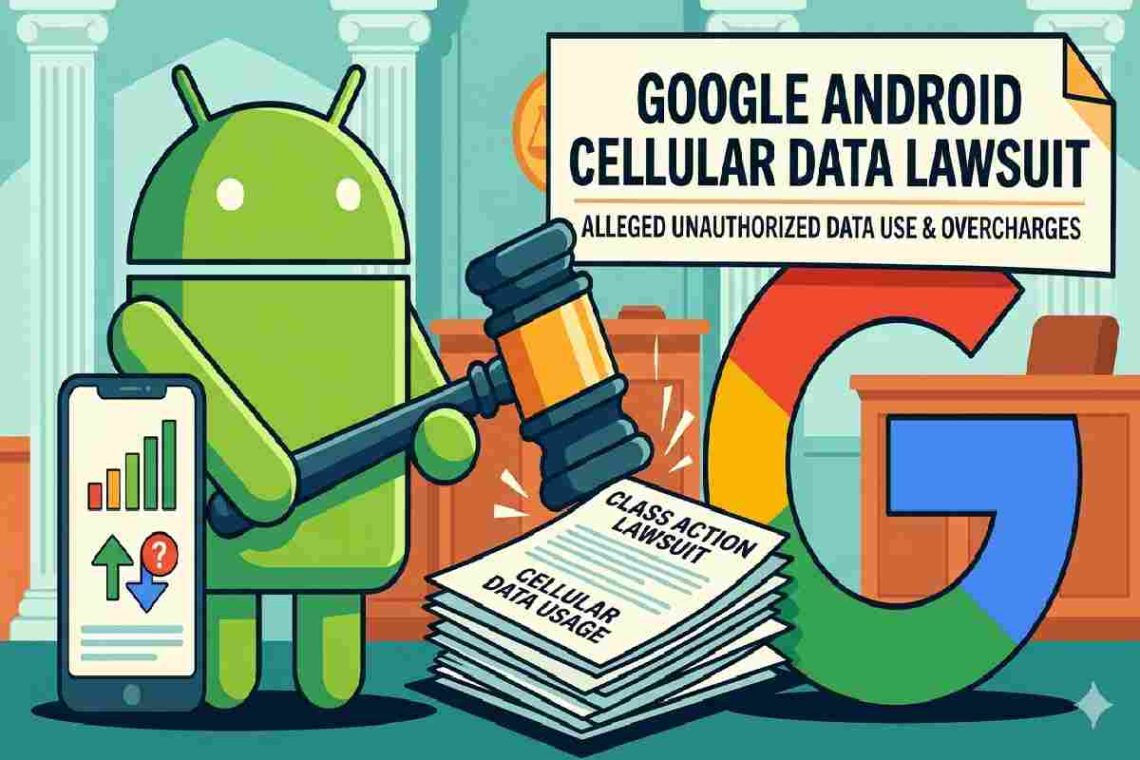
What the Google Android Cellular Data Lawsuit Is About
The Google Android cellular data lawsuit (U.S.) is a class‑action case called Taylor et al. v. Google LLC, which challenges how Google’s Android operating system allegedly used U.S. smartphone users’ cellular data without clear consent..
Case name and underlying facts (Taylor et al. V. Google LLC)
The main case is Taylor et al. V. Google LLC (case no. 5:20 cv 07956). This was a federal class action case brought in a court in California in 2020. The Plaintiffs alleged that the Google-created operating system called Android was set to consume the paid cellular data of U.S.
Smartphone owners as soon as their phones connect to the internet whether the owner is actually using their phone and its applications or not. The case claimed this happened without clear notice or meaningful opt‑out options, framing it as an unauthorized “use” of something users had already paid for.
Rather than let the case go to a full trial, Google agreed to a $135 million class‑action settlement that was preliminarily approved in early 2026 and is now moving into the claims and final‑approval phase.
What Android allegedly did (background data use without clear consent)
The central allegation in the Android cellular data lawsuit is that Android phones continuously sent data to Google’s servers in the background, even when:
- The device was idle, locked, or on the home screen.
- Apps were closed or “off.”
- GPS or location‑sharing settings were turned off.
According to the complaint, these background data transfers happened without giving users clear, transparent choices to stop them. In some filings it is described as “passive data transfers” that took place whenever the phone had an internet connection over a cellular network, effectively using up a slice of the user’s monthly data plan.
The plaintiffs’ theory was that by programming Android this way, Google was using users’ cellular data without explicit permission, arguably turning paid‑data plans into a subsidy for Google’s data collection and analytics.
Harm to users: using paid cellular data without clear permission
The core “harm” claimed in the lawsuit is economic and practical:
- Users pay carriers for a set amount of cellular data each month.
- If Android used that data in the background without clear notice or control, people may have consumed part of their plan without realizing it, leading to:
- Overage charges (if plans were not unlimited).
- Throttled speeds or spikes in data‑usage anxiety, especially on limited or metered plans.
From a legal standpoint, the case presented this as sort of a ‘conversion’-taking a users’ rich cellular data and treating it as something that can be used or accessed without consent. The settlement does not represent a court’s loss for Google; instead it is an agreement for Google to pay $135 Million and improve disclosures without conceding any fault or wrongful act.
$135 Million Android Data Settlement
As part of the settlement, Google (Alphabet) agreed to pay $135 Million into a settlement fund which will be paid out to any eligible United States Android users within the defined class.
This money is:
- Not a government fine, but a civil‑litigation class‑settlement payout.
- Intended partly as compensation for unconsented data use and partly to cover claims‑administration and legal fees.
Why this is a class‑action settlement (not individual lawsuits)
Class action means:
- Only a few named plaintiffs (Taylor et al.) represent and filed the suit on behalf of millions of class members (similarly situated users) who have the same alleged injury as named plaintiffs.
- Upon final settlement approval, class members are each able to share from the settlement fund instead of bringing a lawsuit for themselves.
The key benefit for users:
- You don’t need to prove you personal data use habits in court, as long as you fit within the definition of the class, you can claim your pro rata piece of the $135 million using the settlement procedures.
Important Dates: Filing, Preliminary, and Final Approval Hearing
- Android cellular data lawsuit timing appears as approximately follows:
- 2020: Plaintiff’s initiate Taylor et al. V. Google LLC, a lawsuit filed in federal court alleging Android’s use of data in the background.
- 2025-2026: After years of filing and appeals, a proposal for a $135 million settlement has been filed.
- March 2026: A preliminary approval has been given for the proposed settlement and will advance to the claims stage.
- April 2026 (currently in progress): Claims can now be submitted online via the settlement website and final approval is scheduled (around June 23, 2026 according to some reporting)
Likewise, if the judge gives final approval for the settlement, and it is not appealed, payouts should begin late in 2026 or early in 2027 based on the number of claims received.
Android data settlement eligibility?
Eligibility period (November 12, 2017 through final approval)
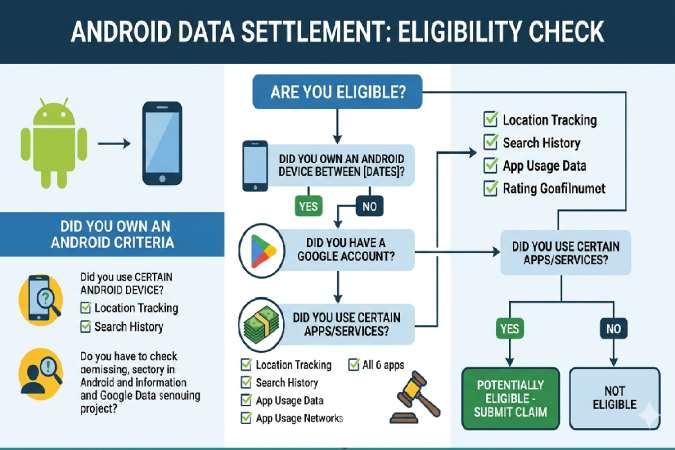
In order to be eligible you must generally be a US resident, AND:
- Own and use an Android powered mobile device.
- Have used a cellular data network to connect to the internet on that device (and NOT only Wi-Fi) between November 12, 2017 and the final settlement approval.
This means:
- The start date is set at November 12, 2017.
- The end date is tied to when the court gives final approval (still to be confirmed, but likely in 2026).
If you used an Android phone via cellular‑data somewhere in that window, you are likely within the broad class definition, unless you fall under one of the exclusions.
What devices count (Android phones using cellular data in the US)
Eligible devices are typically:
- Android‑based smartphones (Google‑branded Pixels, Samsung Galaxy, OnePlus, Motorola, etc.) that ran the Android OS.
- Devices that connected to the internet via a U.S. cellular‑data plan (e.g., from carriers like Verizon, AT&T, T‑Mobile, or MVNOs).
But, the settlement is not limited to specific phone brands; it focuses on:
- The operating system (Android).
- The network type (cellular data in the U.S.).
Tablet‑only Android users may or may not qualify depending on how the final order defines “mobile device,” but the language in major summaries emphasizes smartphones using cellular data.
Who is excluded (Csupo‑case users, certain carve‑outs)
Not every Android user in the U.S. can claim money. The main exclusion mentioned in the settlement documents is:
- People who were part of the separate California case Csupo et al. v. Google LLC*.
In that earlier case, Google also settled claims over data‑related practices, and those users are handled under their own agreement, so they are carved out of the Taylor‑style payout to avoid double‑dipping.
Other possible carve‑outs in the fine print include:
- Users who opted out of the class earlier.
- Users who may have settled directly with Google outside this class process.
If you are unsure whether you were in the Csupo case, you can usually check the settlement website or contact the claims administrator for clarification.
How Much Money Can Android Users Expect?
Total fund size vs millions of users
The total pool is $135 million, but that amount must cover:
- Payments to millions of eligible Android users.
- Claims‑administration costs, legal fees, and service awards to the named plaintiffs.
Because of this, each individual payout is expected to be relatively small unless the number of claims is unusually low.
Per‑person cap and realistic payout expectations
The settlement sets a cap of up to $100 per eligible person, but this is a maximum, not a guaranteed amount.
Realistically:
- If many millions of users file claims, the average payout could be in the single‑digit or low‑tens‑of‑dollars range.
- If claims turnout lower, then people will be nearer to the top limit of cap.
As the actual payoff depends on number of claims received and successful, we must consider it a modest rebate.
Payment method and schedule:
Once the court grants final approval and the claims‑period closes:
- The claims administrator will calculate each person’s share and process payments (often via check or e‑transfer, depending on the payout‑method selections).
- Timeline estimates in coverage suggest payouts likely in late 2026 or during 2027, assuming no major appeals or delays.
If you submit a claim but later appear to be ineligible under the final‑order definitions, your payment may be reduced or denied.
How to File a Claim for the Google Android Data Settlement
The official channel for claims is the court‑authorized settlement website referenced in major news and the docket filings.
Steps to verify it:
- Look for links in trusted news outlets (CBS, Reuters, CNET‑style coverage) that mention the Taylor et al. v. Google LLC case.
- Check the site’s HTTPS URL, case name, and contact details for the claims administrator (e.g., a law‑firm‑branded url or a dedicated class‑action portal).
Avoid unofficial “claim‑assistance” sites that try to upsell services; this is a direct‑to‑consumer process.
Step‑by‑step instructions for submitting a claim
Once you’re on the official site, the process usually involves:
- Confirm eligibility
- The portal will ask whether you used an Android phone with cellular data in the U.S. from November 12, 2017, up to the final‑approval date and whether you were in the Csupo case.
- Provide basic information
- Name, address, and email or phone number where they can reach you regarding the claim.
- In some setups, you may also be asked for one form of identification or carrier‑related details to confirm you are a U.S. resident.
- Choose payment method (if available)
- If you qualify, you may be able to select how you want to be paid (e‑transfer, check, prepaid card, etc.), depending on the administrator’s options.
- Submit and save confirmation
- Keep the confirmation or any reference number provided after you complete the filing.
- The claim is usually processed via web browser and it’s a quick process for many (under 10 mins for many users).
Deadlines and consequences for missing it
- Class action settlements often have firm deadlines by which to make a claim.
- Reports say the claim is open as of April 2026 and is expected to be due later in 2026 or early in 2027 at the latest – this should be detailed in the approved schedule.
- Meet the deadline: you will be part of the settlement fund distribution, depending on the wording in the final order.
- Do not meet the deadline: you will usually forfeit your payout, but are still bound by the settlement anyway.
How This Android Lawsuit Differs from the $425M Google Privacy Verdict
Similarly, $425M tracking‑without‑consent case overview (Web & App Activity)
Similarly, separate from the Android‑cellular‑data case, in 2025 a federal jury in California awarded about $425 million in a different privacy‑tracking lawsuit against Google.
In that case, users alleged that:
- Despite being told their Google searches were no longer being stored when the “Web & App Activity” setting was turned off, consumers had their activity and app history tracked across many of its products and services.
- The jury ruled that Google’s practices were deceptive and users continued to be tracked without explicit consent, resulting in the $425 million settlement.
Key differences: Android background data vs Google‑wide tracking
Here is how the two cases differ:
| Aspect | Android cellular data lawsuit (Taylor et al. v. Google) | $425M Google privacy‑tracking case |
| Core issue | Android using paid cellular data in the background without clear permission. | Google tracking users’ activity even when “Web & App Activity” is off, across apps and services. |
| Harm claimed | Economic harm from using up paid data. | Harm from unauthorized surveillance and lack of privacy, even if data was on Wi‑Fi. |
| Type of outcome | Class‑action settlement approved by a judge (no jury verdict). | Jury verdict in an ongoing privacy‑tracking case. |
| Devices/services involved | Focus on Android‑based smartphones using cellular data. | Broader scope across Google apps and services, not limited to Android‑only. |
Both cases are about consent and transparency, but the Android‑data lawsuit is more about how your phone uses paid data on the carrier side, while the privacy‑verdict case is about how Google tracks you online even when you think you have it turned off.
Conclusion:
The Google Android cellular data lawsuit in the U.S. centers on a class‑action case — Taylor et al. v. Google LLC — that claims Android phones used users’ paid cellular data in the background without clear notice or meaningful consent.
The core issue is that Android allegedly sent data to Google’s servers whenever the phone connected to the internet over cellular networks, even when the device was idle or apps were closed, effectively consuming part of users’ data plans. Rather than a traditional trial, Google agreed to a $135 million settlement, which is now open to claims from eligible U.S. But, Android users who used cellular data between November 12, 2017, and the final‑approval date.